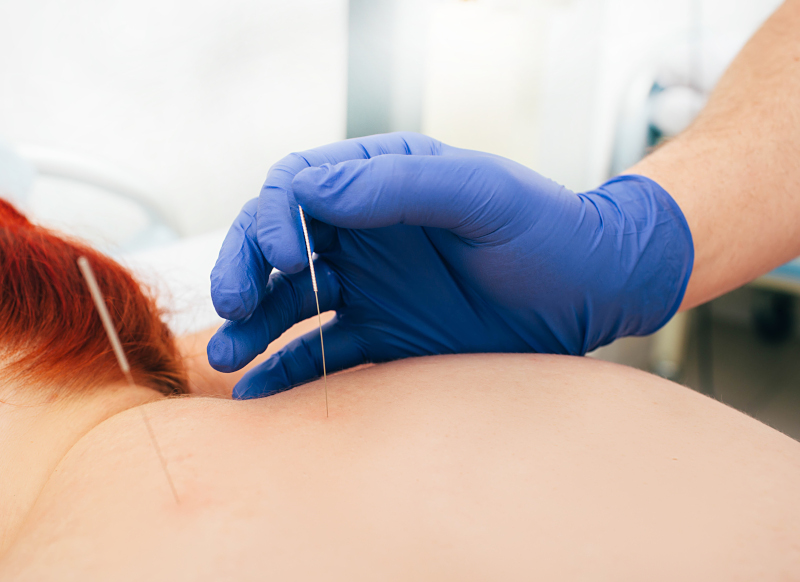
Dry needling is a therapeutic technique used by healthcare professionals, often physical therapists, to alleviate pain and musculoskeletal dysfunction. It involves inserting thin, solid needles into specific trigger points within muscles, tendons, or bone and sometimes includes electrical stimulation. Unlike acupuncture, dry needling focuses on addressing localized musculoskeletal dysfunction rather than balancing energy flow. The procedure aims to reduce pain, improve range of motion and circulation, and enhance muscle relaxation. It is commonly used in conjunction with other physical therapy techniques as part of a comprehensive treatment plan. Please note that most insurances do not c
How does dry needling help with pain?
Dry needling effectively decreases muscle tension and tone, allowing the muscle to relax which increases range of motion and can greatly reduce pain. When your muscles are allowed to relax with the insertion of the needle, it allows for more blood flow. This helps bring fresh blood and oxygen to the affected trigger point/muscle which prompts your body’s natural healing response and can reduce the perception of pain.

With or without e-stim?
Electrical stimulation (e-stim) or Electrical Dry Needling (EDN) is also very common but not applied to every instance or every session. There is low and high frequency e-stim, which is dependent on the type of muscle pain and dysfunction. Dry needling without e-stim is already effective in reducing pain but, with the addition of e-stim, it accelerates the effectiveness, and the positive effects can be longer lasting.
Who are good candidates for dry needling?
Typically, good candidates include those who are experiencing muscle pain, joint pain, tendinopathy or nerve dysfunction. The most popular conditions where dry needling is applied are to those who have:
- Muscular or joint pain — acute or chronic.
- Myofascial pain syndrome (trigger points).
- Sprain, strain, and arthritis/degeneration.
- Chronic pain such as fibromyalgia or neural radiculopathy.
- Limited range of motion and/or postural issues.
- Headaches — tension or suboccipital.
- Whiplash and/or work-related injuries.
Please note that not everyone is a suitable candidate for dry needling. Those with certain medical conditions, bleeding disorders, or a fear of needles may not be ideal candidates. Our certified dry needling providers review and assess each patient’s condition and medical history to determine if dry needling is a safe and appropriate option in their treatment plan.
How many sessions are needed? How long are the sessions?
Patient conditions are of varying complexity; some patients will see results or improvement with just one session, some require several sessions. It is typically recommended to do multiple sessions at a 1x/week frequency.
In terms of duration of each follow-up appointment, it also depends on the complexity. Low complexity cases can take anywhere between 15-30 minutes, while high complexity cases may to anywhere between 45-60 minutes.